Dunnville Master Servicing Plan Update

Through consultants J.L. Richards & Associates Ltd., and CIMA+ we are undertaking an update to the 2009 Dunnville Master Servicing Plan to identify the individual water, wastewater, stormwater, and transportation infrastructure improvements required for future servicing needs in Dunnville and develop an implementation plan for these upgrades.

The first Public Open House was held on December 11, 2024 at the Dunnville Community Lifespan Centre to gather input from stakeholders, rightsholders, and residents.  A second Public Open House was held on May 14, 2025 at the Dunnville Community Lifespan Centre to present proposed servicing alternatives and gather input from stakeholders, rightsholders, and residents. Information presented at both Public Open Houses is available under the Documents and Resources section below.

A presentation was made at the Council in Committee meeting held on October 28, 2025.  

The Master Plan is being placed on public record for a 30-day review period in accordance with the requirements of the MCEA process.  Written comments regarding the Master Plan Project File Report can be provided to the project team by December 4, 2025.

On this page


Project background

The update will fulfill the Phase 1 and 2 requirements of a Schedule B Municipal Class Environmental Assessment (MCEA). At the completion of the MCEA process, we will make the Project File Report available for public and agency review for a mandatory 30-day period.

Background Review and Existing Conditions Update (Complete)

  • Compile and review existing information and prepare working maps
  • Update existing conditions in systems models (water, wastewater, stormwater, transportation)
  • Initiate Public, Agency, and First Nations Consultation Program
  • Conduct Public Information Centre No. 1 and document stakeholder input

Growth Forecast and Assessment of Future Needs (Complete)

  • Review planning projections and distribution of growth
  • Update servicing assumptions and requirements
  • Establish future conditions in water, wastewater, stormwater, and transportation

Development of Preferred Servicing Strategies (Complete)

  • Use constraints to develop a list of servicing solutions
  • Conduct an initial screening of options followed by a detailed evaluation
  • Prepare design concepts
  • Conduct Public Information Centre No. 2 and document stakeholder input

Implementation Plans, Final Report, and Presentation (Complete)

  • Prepare project implementation sheets and final report
  • Presentation to Council

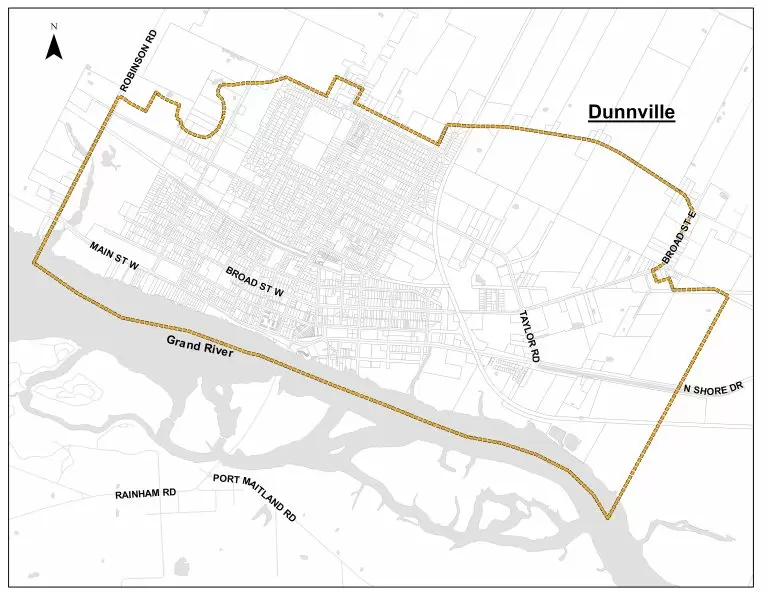
Study area location and map

This Master Plan is being completed for the community of Dunnville, which is located within the eastern part of Haldimand County, just east of the intersection of County Road 15 (Robinson Road) and Highway 3 (Broad Street East). The study area boundary encompasses the urban boundary of Dunnville.


Status and updates

This Master Plan is being placed on public record for a 30-day review period in accordance with the requirements of the MCEA process. Written comments regarding the Master Plan Project File Report can be provided to the project team by December 4, 2025.. 


Public engagement

We want to hear from industry, businesses, and residents about the Master Servicing Plan.

The Master Servicing Plan Update included a public engagement and consultation program with a variety of outreach opportunities to applicable groups and seeking input from interested parties, individuals, businesses and groups in Haldimand County.  This ensured the proposed alternatives were thoroughly reviewed by all interested parties.

Two Public Open Houses have been held to present information to the public and gather input from stakeholders, rightsholders and residents on the proposed servicing alternatives.

Following the Council adoption in Fall 2025 of the Master Servicing Plan study, the Project File Report will remain available for public and agency review until the end of the mandatory 30-day review period. If you have any comments or questions, please reach out to one of the project contacts below. 

Not all documents may be accessible to all users. If you require any special accommodation to access the project information or online material, please email accessibility@haldimandcounty.on.ca and we will work together to best share the information with you.


Project contacts

Jane Wilson, P. Eng.
Senior Environmental Engineer
J.L. Richards & Associates Limited
107-450 Speedvale Avenue West
Guelph, ON  N1H 7Y6
Phone:  226-780-7487
Email: jwilson@jlrichards.ca

Philip Wilson
Manager, Water & Wastewater Engineering
Haldimand County
53 Thorburn St. South
Cayuga, ON  N0A 1E0
Phone: 905-318-5932 ext. 6431
Email: pwilson@haldimandcounty.ca

Jessica Davidson
Project Manager, Water and Wastewater Capital Projects - Water & Wastewater Engineering
Haldimand County
53 Thorburn St. South
Cayuga, ON  N0A 1E0
Phone:  905-318-5932 ext. 6272
Email:  jdavidson@haldimandcounty.ca


What is a Municipal Class Environmental Assessment?

The Municipal Class Environmental Assessment (EA) is an approved process that municipalities must follow under the Ontario Environmental Assessment Act. Class EA projects are classified in terms of schedules (A, B or C) depending on the degree of impact on the environment.

Exempt Projects

Formerly known as Schedule A and A+ projects, these projects are exempt from the requirements of the EAA. They are generally limited in scale and have minimal adverse effects on the environment.

Eligible to be Screened to Exemption 

These projects are eligible for exemption based on the results of a screening process. If as a result of the screening process the project is not exempt, the applicable schedule B or C assessment process must be completed. Proponents can also choose at the outset to not follow a screening process and just complete the applicable B or C process.

Schedule B 

These projects have the potential for some adverse environmental effects. As part of the process, the proponent is required to consult and a Project File Report must be prepared and made available for review by the public, government agencies and Indigenous Communities.

Schedule C 

These projects have the potential for more significant environmental effects than a Schedule B project and must proceed through the full planning and documentation process, including consultation. An Environmental Study Report must be prepared and made available for review by the public, government agencies and Indigenous Communities.

Phase 1: Identify the problem (deficiency) or opportunity.

Phase 2: Identify alternative solutions to address the problem or opportunity by taking into consideration the existing environment, and establish the preferred solution taking into account public, Indigenous Community and review agency input. At this point, determine the appropriate Schedule for the undertaking (see Appendix 1) and document decisions in a Project File Report for Schedule B projects, or proceed through the Phases 3 and 4 for Schedule C projects.

Phase 3: Examine alternative methods of implementing the preferred solution, based upon the existing environment, public, Indigenous Community and review agency input, anticipated environmental effects and methods of minimizing negative effects and maximizing positive effects.

Phase 4: Document, in an Environmental Study Report a summary of the rationale, and the planning, design and consultation process of the project as established through the above Phases, and make such documentation available for review by agencies, Indigenous Communities and the public.

Phase 5: Complete contract drawings and documents and proceed to construction and operation; monitor construction for adherence to environmental provisions and commitments. Where special conditions dictate, also monitor the operation of the completed facilities.

Contact Us

Haldimand County
53 Thorburn Street South
Cayuga, Ontario
Canada, N0A 1E0

Phone: 905-318-5932

After hours (Road, Sewer, Water or Park & Public Facilities Emergencies): 1-888-849-7345